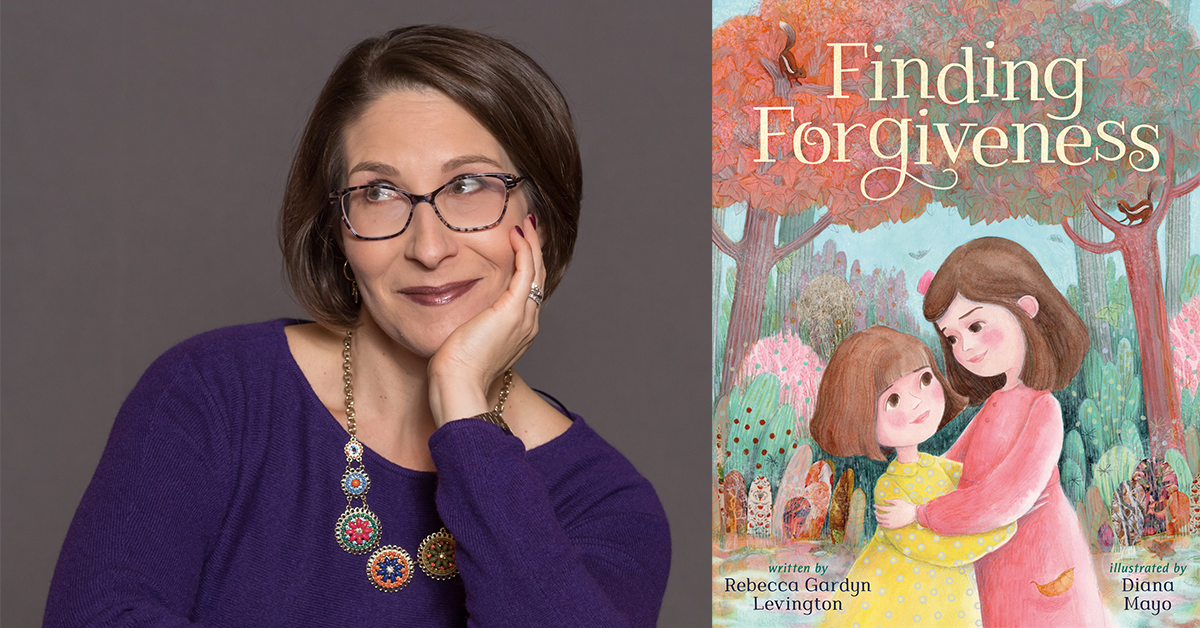
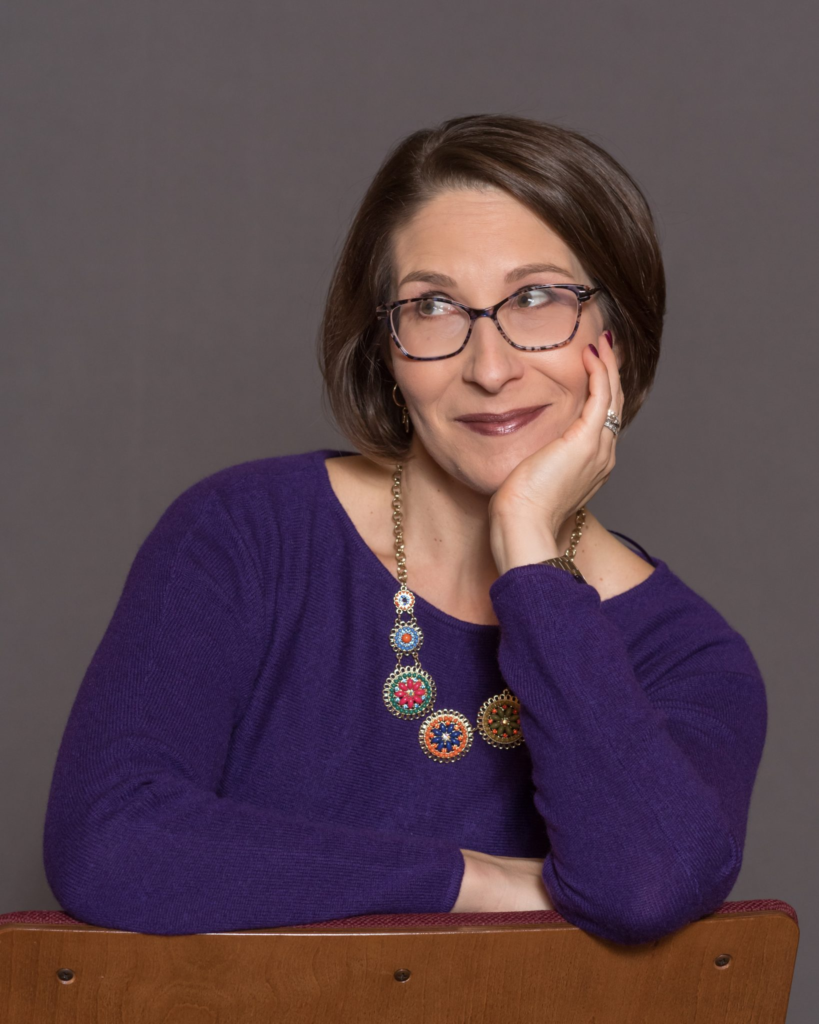
Rebecca Gardyn Levington is a children’s book author, poet, and journalist with a particular penchant for penning both playful and poignant picture books and poems – primarily in rhyme. She is the author of WHATEVER COMES TOMORROW (which has been translated into nine languages and is the winner of a Crystal Kite Honor and a Northern Lights Book Award), AFIKOMAN WHERE’D YOU GO? and FINDING FORGIVENESS (both PJ Library Selections), BRAINSTORM!, LITTLE DREIDEL LEARNS TO SPIN, WRITE HERE WRITE NOW, SOME DAYS I’M THE WIND, DINOSAUR SURPRISE!, and I WILL ALWAYS BE… with many more books forthcoming. Rebecca blogs monthly for the Picture Book Builders and her award-winning poems and articles have appeared in numerous anthologies, newspapers, and magazines. Find out more and sign up for Rebecca’s monthly newsletter at www.RebeccaGardynLevington.com.
FINDING FORGIVENESS
The theme of finding forgiveness is a universal one. It is beautifully explored in this lovely book as a young family celebrates Rosh Hashana. The Jewish New Year custom of Tashlich, casting off your past mistakes, stresses making amends for past hurts and trying to do better in the next year. When a young girl has just fought with her sister, she is sad that she has made her little sister cry. In this lyrical poem the reader follows the little girl’s thoughts about her sister and how she asks forgiveness. The meter and rhyme tell the story in a sweet manner, and it all flows effortlessly. The pastel illustrations by Diana Mayo add a dreamy softness that complements the text and provides a calm meditative mood. The afterward includes an authors note, a section with suggestions for apologizing meaningfully and a glossary. Most Rosh Hashana picture books don’t go beyond the shofar or the apples and honey. This one touches on the meaning of the occasion in an age appropriate manner. This is a perfect book for Jewish youngsters, but the themes of family and forgiveness are universal and little ones of any faith can empathize and learn from the characters in this story.
INTERVIEW WITH REBECCA
Story Beginning
Rebecca, Thank you so much for chatting with me, I love this story. Saying “I’m sorry” and meaning it, is such a difficult thing for anyone, but especially young children. How did the story Finding Forgiveness come about? Was it inspired by your own experiences?
This story actually started with a call for poems by Ladybug magazine in the summer of 2021. They were looking for poems about “traditions and rituals” and, since I love a good writing prompt, I started brainstorming about various Jewish traditions and rituals that I find meaningful. I’ve always loved the Tashlich ceremony, which takes place on the afternoon of the first day of Rosh Hashanah, the Jewish new year. It is a ritual that is all about finding forgiveness – by making amends with those we’ve harmed and by giving ourselves grace for our missteps. The original poem was 5 stanzas long and had a little sidebar about the ceremony. I actually remember being happy when Ladybug decided not to publish the poem because I was excited about the idea of playing with it more and maybe turning it into a picture book. I’m so glad I decided to go with my gut!
And yes, like the main character in this book, I too have a younger sister and our relationship as children was filled with arguments like the one depicted in the book. I also have two boys and see similar frustrations and miscommunications creep up between them as well. Sibling relationships are tough for anyone to navigate, and it is particularly hard for kids, who are still learning that the world doesn’t always revolve around their own experience and point of view. I think it’s important that picture books help model empathy and healthy communication between siblings so they can see that other was to handle a situation and learn to see things from others’ points of view.
Rosh Hashana
Although making amends is a universal concept, the setting of Rosh Hashana is a perfect backdrop for a story with that theme. However, you made an effort to make this book appropriate to readers of any background. The afterward not only includes the section that talks to kids about how to say “I’m sorry,” but also an explanation of Rosh Hashana and a glossary of Hebrew terms. Did you have any pushback from the publisher about including those items?
Pushback? Not at all! In fact, the Jewish angle of this book is one of the reasons my editor, Joy Peskin, told me she loved it so much. The Author’s Note and glossary were there from the beginning and she welcomed and championed for both completely. In fact, at one point, one of the copyeditors wanted to cut some of the explanations from the glossary for space reasons and Joy stepped in to be sure it all stayed in. True, when I submitted the manuscript, it had the subtitle “A Rosh Hashanah Story,” and the decision was made to remove that. But I was 100% on board with that. As you note, this book is truly a universal story and we want to be sure it reaches as many kids as possible. We didn’t want kids (or adults) to think that this is ONLY a book for people who celebrate Rosh Hashanah, even though the setting and rituals obviously play a huge role in the story. This is a book for EVERYONE.
Illustrations
The illustrations by Diana Mayo are absolutely beautiful. I love the muted color palate which provides a perfect mood and the expressive faces. How many illustration notes did your original manuscript contain, if any?
I couldn’t agree more! Diana’s work is absolutely stunning! And her work is particularly impressive, I think, because Diana isn’t Jewish. She took great care in making sure all the details were just right, asking for photo references and guidance along the way whenever she wasn’t sure about something. She did such an incredible job that I asked that she also illustrate my second book with FSG about Shabbat which is coming in 2027 (more on that later!)
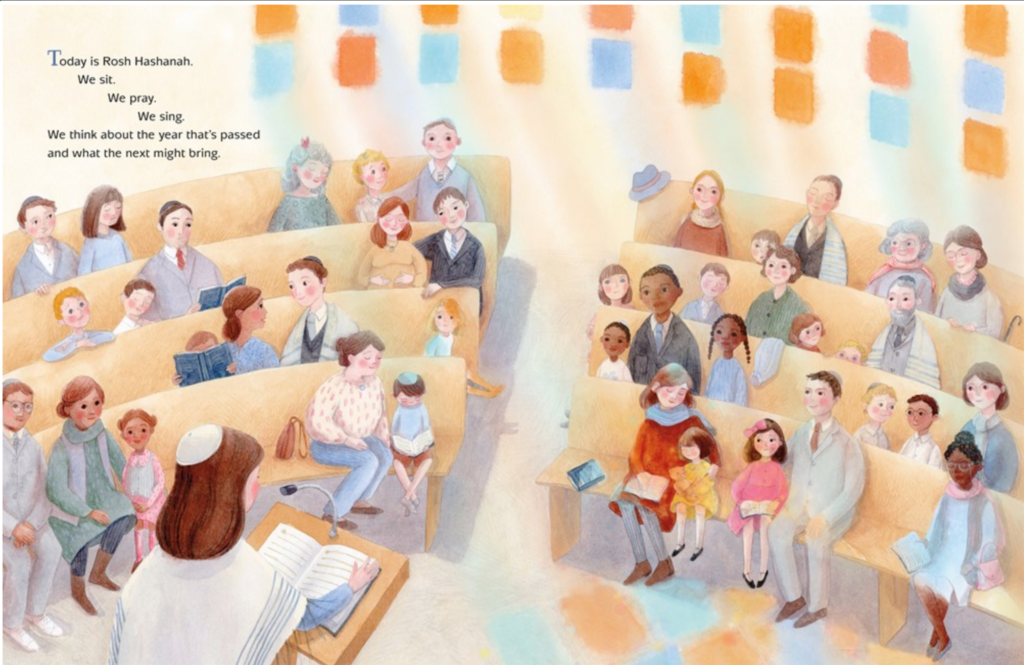
But back to your question. I know there are different views about art notes. I personally feel like they are important to include, particularly when they are, as author Tara Lazar likes to say, “action notes.” Sometimes there are things that are happening in the art that aren’t in the text, and that needs to be communicated. For this story, I had a handful like that. For instance, for the opening spread, my art note was: “Two sisters sitting in synagogue with family,” and later, “the congregants walked to a park with a river flowing through” and “after throwing bread, little sister has wandered to the near-by playground.” But in terms of WHAT that would look like, I left all that to Diana.
I noticed how the artist picked up on your word choices, especially how the phrase “The river glints and glimmers, reflecting my regret,” became an illustration with the upside-down reflection of the girl. Was that planned? Were there any other things in the illustrations that were unexpected?

I absolutely LOVE that spread. It’s so beautiful, which is why that image made it onto the back jacket as well. Was it planned? I mean, I never put any sort of art note about it, if that’s what you’re asking, but I think there are ways for writers to plant little hints about what they envision within the text. I chose to use the word “reflecting” very purposefully. The girl is reflecting upon her missteps AND she is looking down at the water at her reflection. So yes, I was hoping Diana would pick up on that double-meaning and run with it, but I could never have imagined how gorgeous the final spread would ultimately be. That’s all Diana’s brilliance.
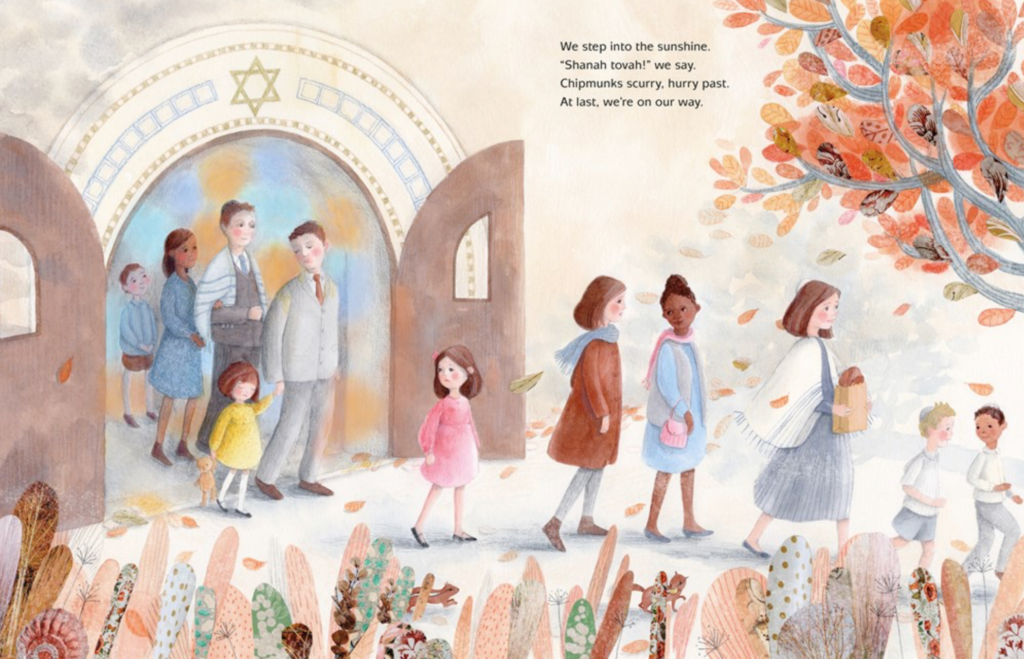
One surprise in the illustrations was Diana’s inclusion of a pair of chipmunks who skitter along playfully throughout the spreads of the book. Going back to your observation about Diana picking up things in my text to inspire her illustrations, there is a stanza that reads: “We step into the sunshine/ ‘Shanah tovah’ we say. /Chipmunks scurry, hurry past. /At last, we’re on our way.” Diana chose to pick up on that tiny detail about the chipmunks and run with it. It was 100% her idea to include the little creatures throughout the book. I think their cuteness adds a wonderful layer of levity to the story and I think kids will enjoy searching for them in each of the spreads.
Did you feel the need to change any of the text to match the illustrations?
I have had to do that on other projects, but not this one.
Rhyme
Writing in rhyme is not as easy as some would think. Poetry is more than just rhymes. There is rhythm and meter to consider. Often a picture book will have poetry with awkward word choices to force the rhyme or phrases that don’t flow and feel forced. Your text always flows so well. What is your secret?
There really isn’t any big secret. I’ve just taken the time to learn what I’m doing. You are right that some people think “cat” rhymes with “hat,” so what’s so hard about “that”? But in order to write a story in rhyme that FEELS easy and can be read flawlessly by ANYONE, requires an understanding the mechanics of meter — how words have natural stressed and unstressed syllables and that by placing words in a particular order, you can create specific rhythms. Writing picture books (as opposed to poems) increases the difficulty because the story ALWAYS has to come first. You can have the most wonderful rhymes and perfect rhythms, but if the story doesn’t make sense or goes off on unnecessary tangents, it isn’t going to fly.
I’ve worked really, really, really hard over the last decade – taking classes, reading and studying thousands of rhyming picture books and poems, swapping manuscripts with other incredible rhyming authors, getting professional critiques, etc. — to truly master the ins and outs of rhyme, meter, and lyrical language. For those who want to put in the work, I will say that the absolute BEST thing I ever did for my career was to take Renee LaTulippe’s Lyrical Language Lab class. Renee offers an “Interactive Course” in which she offers feedback, as well as a “Self-Study” option. I highly recommend the former if you can afford it and the scheduling works, but either will give you everything you need to know. Renee also has a fabulous FREE YouTube channel. (And no, I don’t get any kickbacks from Renee. I’m happy to spread the word because I absolutely believe her class helped me take my writing to an entirely different level).
All your books are in rhyme. Have you ever considered writing a story in prose?
All the books I have had PUBLISHED are in rhyme, but that doesn’t mean I haven’t written stories in prose. I definitely have, especially when I first started out. Actually, I recently had a project that I tried to tackle from many different angles, and one of those drafts was in prose (it was still sort of a free-verse poetic style, though). I didn’t hate it, but I didn’t love it, and ultimately returned to rhyme. There’s just something about sound and rhythm of words and how they can come together in new ways to create a specific mood or emotion. I enjoy puns, idioms, lyrical language and trying on different points of view. I love writing in rhyme because, to me, a rhyming poem or picture book is one big puzzle. When, after hours of tinkering, I’m able to uncover the perfect word that exactly encapsulates the meaning and feeling I’m after AND perfectly slides into my meter, I get SUCH a high!
New Books
Your debut picture book, Brainstorm was published only three years ago and you have taken the industry by storm with five more published books. I understand you have several more books in the pipeline. Can you tell my readers about what to expect soon?
Sure! Actually, as of this September, I will have nine books published, and I have six more currently under contract, so that’s a total of 15 rhyming picture books and board books! I still can’t believe it, to be honest. I’ve been very lucky to work with some incredible editors and illustrators.
My next two books, both out on Sept. 9th, are SOME DAYS I’M THE WIND (Barefoot Books), illustrated by Dinara Mirtalipova, and DINOSAUR SURPRISE! (Highlights Press), illustrated by Teresa Bellon. Here are the blurbs:
SOME DAYS I’M THE WIND is a lyrical picture book that encourages kids to be true to who they are, even when “who they are” is constantly changing. Like the wind, which on some days is “whirling and wild” and on others “mellow and mild,” we cannot be described, defined, or labelled in any one way. Each day, our moods, feelings and reactions to the world inevitably shift and drift depending on our circumstance, but we are always, on all days, uniquely ourselves.
DINOSAUR SURPRISE! is an interactive board book about… dinosaurs, of course! Babies and toddlers will delight in joining real dinosaurs in a rhyming story, and then—surprise!—lift the felt flaps to reveal silly ones. The last page features a mirror under the flap where little “babysaurs” can practice their silliest faces. This is the perfect book to help little ones develop early humor and fine-motor skills while they laugh and play with caregivers.
AND, as I mentioned earlier, I’m happy to report that Diana Mayo will be also be illustrating LOOKING FOR LIGHT, coming from FSG sometime in winter 2027. I’ve already gotten to see some of the initial sketches from Diana and, once again, she has created absolute magic. Here’s the blurb for that one:
LOOKING FOR LIGHT is poetic picture book about a child learning how to notice and find gratitude for life’s small joyful moments. With the Jewish holiday of Shabbat as a backdrop and told from the unique perspective of “the Light,” this story encourages children of any background to take time each week to reflect upon the good in their lives.
Learn More