
Ana María Shua Interview
& Passover Pet Surprise
Book Giveaway
Argentinian author Ana Maria Shua has written a new children’s book that has just been published in English as well as Spanish. Passover Pet Surprise (La gran sorpresa de Pésaj) follows an American family who visits relatives in Argentina for Passover. This amusing multicultural holiday story explores the meaning of freedom in a new light. The author has graciously answered a few questions about her work. NorthSouth Books is also providing a GIVEAWAY of Passover Pet Surprise to one lucky reader.
Make sure you enter the Giveaway at the end of the post!
Interview with Ana María Shua
Q. Ana, you are certainly a prolific and versatile author. You started writing poetry as a teenager, and then you went on to write award winning novels and became the queen of micro-fiction, not to mention numerous children’s books. How did you end up writing in so many genres?
A. Tell me what you read and I’ll tell you what you write! No mystery: I am a very eclectic reader, and that’s why I write in so many genres. I love to write stories in every possible form: novels, short stories, flash fiction (or micro-fiction). I have never written drama, but I did write several movie scripts and two of them were actually filmed (filmed, not recorded—this was many years ago). I have to explain that Latin American cinema is a constant source of failed projects. Anyway, I never felt I was a great scriptwriter. I don’t love writing dialogue and I would rather write narrative.
Q. Different sources vary on the number; just how many books have you written? Do you have a writing routine that accounts for such a vast body of work?
A. I’m not sure… I should count them again. The number is about 180. For a while it was fashionable in my country to publish very short little books that were sold in boxes. Publishers used to ask me for eight very short stories, and each one of them was transformed into a separate book. Then the eight stories were published all together again in a hardcover book. Besides that, I wrote many versions of legends and traditional anonymous stories. I guess all children’s book writers have written a lot of books, simply because many of them are very short. And I’m counting the anthologies (collections) too. I wrote about thirty books for adults, which is not that much in so many years, considering that my first poetry book was published in 1967.
Q. I adored your new book The Passover Pet Surprise, and I am so glad that NorthSouth Books has published this book in both a Spanish and an English edition. I was surprised when I looked at your website to discover over sixty children’s books pictured. And yet I couldn’t find any of them available in English anywhere. Have any of your other children’s books been translated into English?
A. No, this is my first children’s book translated into English. In fact, [The Passover Pet Surprise] has never been published before in my own country. NorthSouth published the first Spanish edition as well. Macmillan, McGraw-Hill, and Houghton Mifflin have published some of my short stories in translation as part of anthologies or school books, but they never chose to publish a whole book. Seven of my books for adults have been translated and published in the United States, but always by very small or university presses.
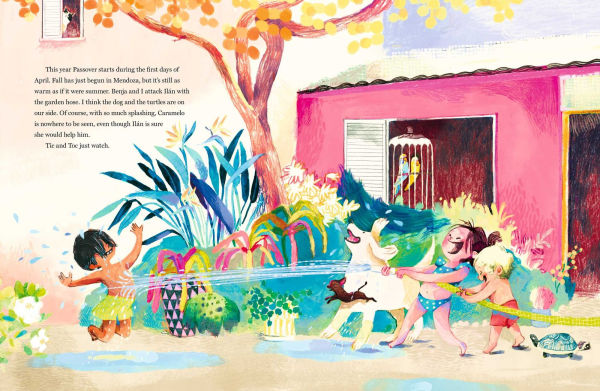
Q. I love the Spanish that is woven into the book: knéidalaj matzah balls and maté tea, expressions like “Ay, Dios mío!” and “Quizas, amor”, and of course the animal words. Readers could have inferred the meaning from context, but the animals are labeled in Ángeles Ruiz’s first fantastic illustration. Was that your idea or hers?
A. Well, knéidalaj is not Spanish but Yiddish… And we never call knéidalaj “bolas de matze”; it doesn’t sound right in Spanish. Mate is mate—there is no translation. I remember that one of my first translators wanted to change the mate in my novel The Book of Memories into tea! It’s not the same at all. You drink tea from a cup; you slurp mate from a… mate, using a bombilla, a kind of metal straw that you share with everyone around you. The rest of the Spanish words and expressions were an idea of my editors, and I think it was a great decision. Of course I absolutely adore Ángeles Ruiz’s illustrations. I think they add meaning to my words and improve the story in a wonderful and unexpected way.
Q. Authors and illustrators usually work completely independently. Did you provide any art notes in the manuscript or have any surprises in the illustrations that required changes?
A. No, I did not provide any art notes. I don’t have graphic ideas—that is not how my mind works. Even so, I understand a little about visual communication because I worked for fifteen years in advertising as a copywriter, from the age of nineteen to thirty-five. There were no surprises, because Ángeles asked me about every doubt she had (always through my editors—we never talked or wrote directly to each other): for example, what color the little parrots in Mendoza could be, what a real Argentine parrilla looks like, and many other details.
Q. The Passover Pet Surprise combines a multicultural look at the Passover customs with the theme of freedom, the reason for the holiday. What was the story seed for the The Passover Pet Surprise? Was it based a real event? Or simply inspired by the idea of freedom?
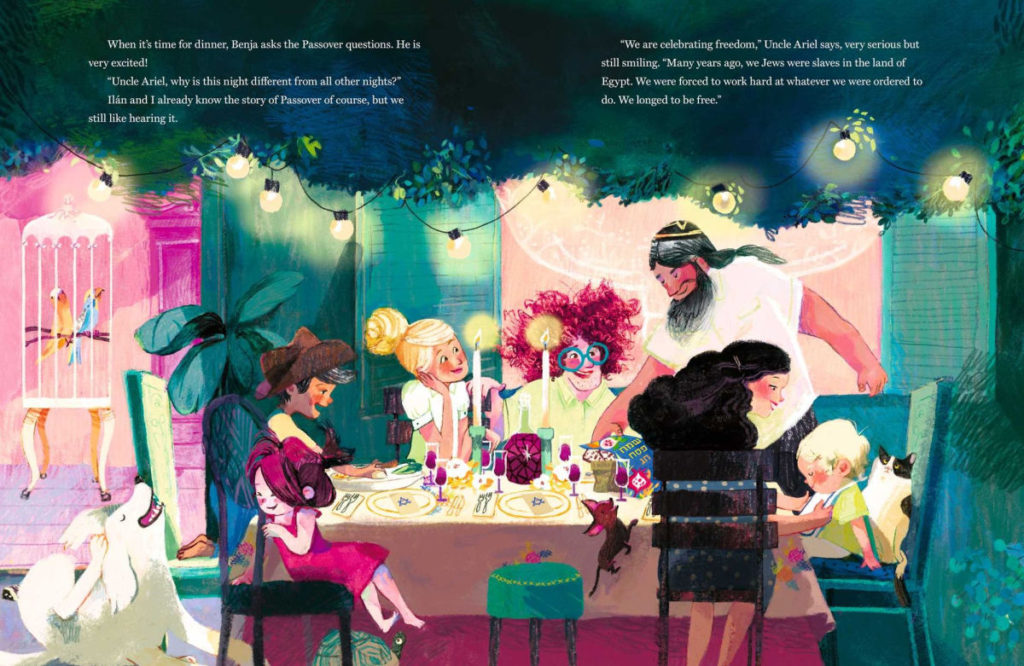
A. The core of the story—how Jordanita opens the cage because of what she understands about Jewish people, Passover, and freedom—just occurred to me. It was not based on a real event. But many parts of the story are somehow autobiographical. I have a large family in the United States, because my grandfather came to Argentina from Poland while his six siblings went to the U.S. They had children, and those children had children, so I now have a huge extended family all over the United States—about a hundred people, I guess. Many of them hardly know each other, but they have met us, because whenever one of them comes to Argentina they come to meet the Argentine branch of the family. And that is not all: my own sister had to flee my country during the last bloody dictatorship. She is married to an Argentine man, and they come to Buenos Aires twice a year, as do their daughter and son and their spouses—maybe not so often for the second generation. But my niece and nephew speak good Spanish and they love Buenos Aires. I live in an apartment, as most people in Buenos Aires do, and when my daughters were little I had tropical fish, little parrots (cotorritas) that we named Tic and Toc, and cats that tortured our turtles. And yes, I remember now that Tic and Toc were fragile creatures. One of them died, that happened twice, and we had to buy another one because they cannot live alone. In the end we took the cage to the balcony and opened the door—and the last Toc flew away.
Q. I love that Jordanita is a kid who takes action. But did you have any pushback from the editors who might have been concerned that kids would try to copy her actions?
A. No, not at all. They loved the story from the beginning, and that was already the basic structure of the story. In fact, I think it is not so common nowadays to keep birds in cages.
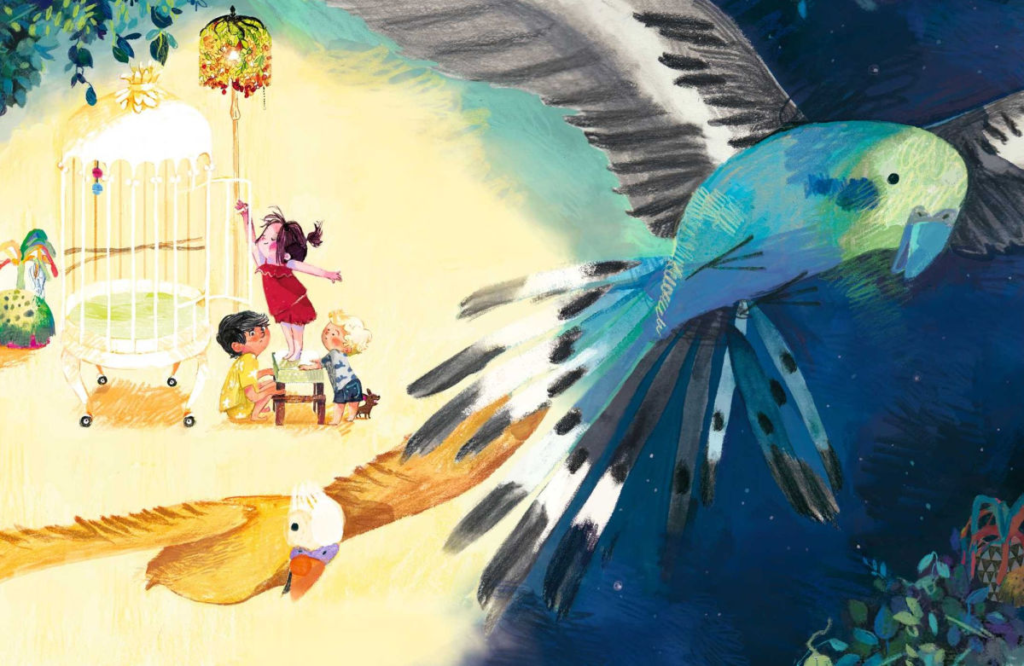
Q. Towards the end of the book, the family are “all laughing, imagining the adventures of Tic and Toc.” That is such a great lead in for a possible series. Are there any plans for books about their adventures? Do you have any more English language books on the horizon that we can look forward to reading?
A. I don’t know—I never imagined telling the adventures of Tic and Toc. This is a brand-new idea you are giving me! And yes, one of my poetry books for adults, They Are Not Haikus, is currently being translated by an American poet named Zack Rogow. Besides that, all my books for adults in English are sold on Amazon, so they are there, ready to be read. Thank you for your kind question
Q. Thank you for taking time to answer my questions. Your English language interviews are rare and I feel privileged to share your thoughts with my readers. Is there anything else that you would like to mention here?
A. No, your interview was very interesting for me, and I didn’t have to use— you know—those pre-prepared answers we writers usually have. You made me think! Thank you very much for your interest in my book.
About Ana María Shua
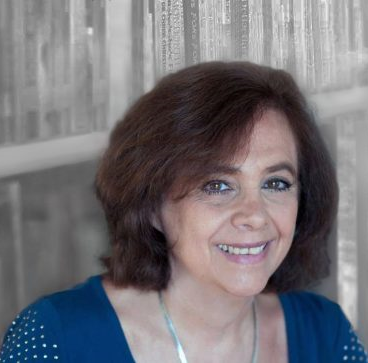
Ana María Shua has earned a prominent place in contemporary Argentine fiction with the publication of many books in nearly every genre: novels, short stories, short short stories, poetry, children’s fiction, books of humor and Jewish folklore, anthologies, film scripts, journalistic articles, and essays. She is best known as the Spanish language “Queen of microfiction” These are short short stories which tell a complete story in 300 words or less, fitting a full story into a tiny space.
Born in Buenos Aires in 1951, Shua began her literary career at sixteen with the publication of El sol y yo (The Sun and I), a volume of poetry which received two literary prizes in 1967. Since then, she has received numerous national and international awards, and a Guggenheim Fellowship for her novel El libro de los recuerdos (The Book of Memories, 1994). Her other novels include Soy Paciente (Patient, 1980), Los amores de Laurita (Laurita’s Loves,1984), which was made into a movie, La muerte como efecto secundario (Death as a Side Effect, 1997). and El peso de la tentación (The Weight of Temptation, 2007). Her award-winning works have been translated to many languages. She has written numerous children’s books as well, which won national and international awards, are read throughout Latin America and in Spain.
Learn More about Author

Find out more about Author and her books at anamariashua.com
Just right click to translate the Spanish language website to English.

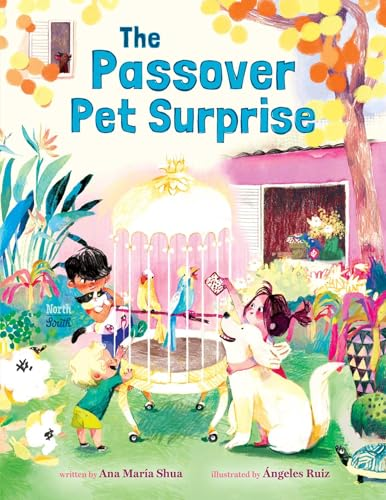
The Passover Pet Surprise
By Ana María Shua, Angeles Ruiz (Illustrator)
This multicultural picture book is an absolute delight that will introduce readers to two different cultures. Jordanita and her family live in Miami, but they are spending Passover with their relatives in Argentina. Author Ana Maria Shua has written a sweet story that weaves together, Spanish vocabulary, Jewish tradition, and a loving family. Throughout the story, the author mixes in Spanish words and phrases which kids will understand through the context of the story. Traditionally, the youngest child asks the four questions about the Passover Seder. Instead of a set response from a Haggadah, the adults answer in simple sentences that are easy enough for young kids to understand. Because Passover is a holiday about freedom, Jordanita, decides that the pet birds should be free too. The family is naturally upset, but they understand that she only meant well. The situation is handled with gentleness and children will learn that it was a mistake and not try to emulate her behavior. However the story can lead to great discussions of what it means to be free. This sweet book is a perfect multicultural book that highlights Jewish diversity. The book serves as a mirror to Jewish or Hispanic children and introduces two cultures to the rest of the readers. I accessed an electronic advance copy of this book from the publisher as part of the Read Your World diverse children’s books program. However all opinions are my own.
About the book
Picture Book
Publisher : NorthSouth Books
Publication date : March 3, 2026
Print length: 32 pages

Picture Book
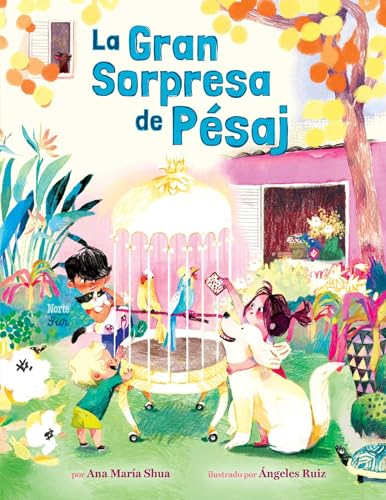
Publisher : Ediciones NorteSur
Publication date : March 3, 2026
Print length: 32 pages
Read my reviews of the author’s books at Goodreads on my Children’s Books shelf.
GIVEAWAY!
Passover Pet Surprise
Passover Pet Surprise
Giveaway Ends March 14
Enter Now.
HOW TO ENTER THE GIVEAWAY:
Leave a comment on this post.
For bonus entries let me know in the comments if you do any of the following:
(You can always come back and comment about a new follow or share. Be sure to mention your account name.)
Follow Storybook Lady
Follow Author on Social media:
Shared this post to your social media
Share the Facebook posts about this article.
Share the Instagram posts or stories.
I love the idea of this book. And will be getting a copy for my niece and nephew! Thanks for the interview.
This book is a fun story and a great discussion starter too.