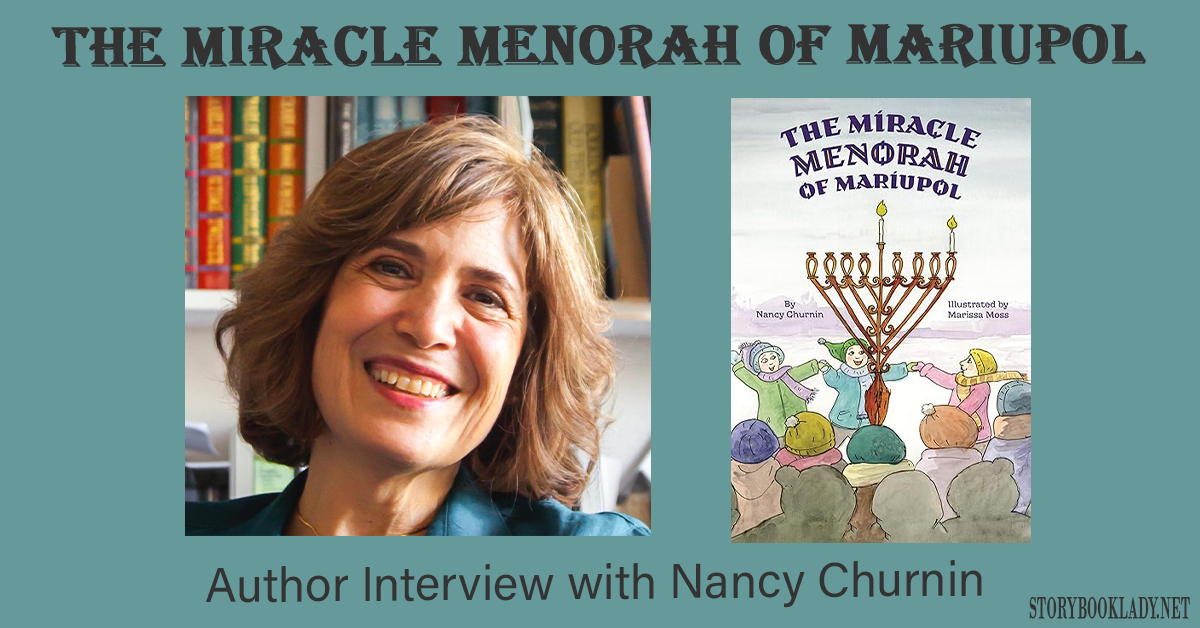
Nancy Churnin writes books about people who have made a difference. A few of her biographies are about famous people, but many are about the people who don’t make the headlines. Last January, I interviewed her about her award winning book, Martin & Anne: The Kindred Spirits of Dr. Martin Luther King, Jr. and Anne Frank. This time, Nancy answered a few of my questions about her career as well as her newest book. She usually takes a page out of history, but her latest story, “The Miracle Menorah of Mariupol“, brings current events to children in a way that they can find accessible. Intrigued by an article about a modern day miracle in war torn Ukraine, she frames the war between Ukraine and Russia with a comparison to the miracle of Hanukkah.
About Nancy Churnin

NANCY CHURNIN is an award-winning children’s book author who writes books about people who have made the world a better place and inspire children to be heroes and heroines, too. She won the 2021 National Jewish Book Award and 2022 Sydney Taylor Honor for Dear Mr. Dickens, a true story that is the subject of an educational program offered by The Charles Dickens Museum in London, and two Sydney Taylor Notables, for her 2021 A Queen to the Rescue, the Story of Henrietta Szold Founder of Hadassah and 2018 Irving Berlin, the Immigrant Boy Who Made America Sing. Born and raised in New York City, Nancy lives in the Dallas area. Among her other book honors: Texas 2X2, Topaz Award, National Federation of Press Women First Place Award; Texas Federation of Press Women First Place Award; the South Asia Book Award; Sakura Medal finalist; Books for a Global Society Notable; two Junior Library Guild selections; multiple Social Studies Notable Trade books for Young People; multiple Kids Choice Awards finalists; multiple Silver Eureka Award-winners; multiple Bank Street College Best Children’s Book List books; multiple A Mighty Girl books; 10 books featured on socialjusticebooks and starred reviews from School Library Journal, Kirkus Reviews and Publishers Weekly. All her books come with free teacher guides, resources and projects on her website, nancychurnin.com
Interview with Author
Q. You have around two dozen books that have been published in the past 10 years. But before you became a full-time author, you were a journalist. What started your journey into writing children’s books?
A. I had dreamed of writing children’s books for as long as I can remember. In fact, I recently discovered, going through my mom’s belongings this year, that I had actually written that very thing, that I dreamed of writing books for children, in a school assignment she had saved from seventh grade. I had no idea how to become this thing I was dreaming about, however. I became a journalist because I love telling stories and I wanted to earn my living doing something I loved doing. It was not until I became friends with a Deaf man named Steve Sandy who shared his dream that more people would know about the great Deaf baseball player William Hoy that I realized I had to turn Hoy’s story into a book for kids.
So, for me the turning point was to make someone else’s dream come true – Steve’s – and to do right by someone who deserved recognition – William Hoy. That was the catalyst I needed to turn a dream into the reality of my first book, The William Hoy Story, How a Deaf Baseball Player Changed the Game, illustrated by Jez Tuya (Albert Whitman, 2016), which is on many state reading lists and has been translated into Spanish, Japanese, Korean, and Swedish. And that, for me, has been the magic ingredient ever since. Will this book I am working on help someone? Will it bring recognition to someone who is deserving? Will it inspire readers to be kind, to be heroes of their community, too?
Q. You have such a wide variety of stories, where do you find your inspirations?
A. Sometimes I have found them in newspaper articles that moved me: Manjhi Moves a Mountain, illustrated by Danny Popovici (Creston Books, 2017); Rainbow Allies, the True Story of Kids Who Stood Against Hate, illustrated by Izzy Evans (Beaming Books, 2024). Once I fell in love with a painting of Marian Anderson and had to learn about the painter; that led to Beautiful Shades of Brown, the Art of Laura Wheeler Waring, illustrated by Felicia Marshall (Creston Books, 2020).
Often, they have sprung from things I have been curious about, such as where do our Halloween traditions come from, which became Lila and the Jack-o’-Lantern, Halloween Comes to America, illustrated by Anneli Bray (Albert Whitman, 2023). Wondering who made Valentine cards popular in America led to Valentines for All, Esther Howland Captures America’s Heart, illustrated by Monika Roza Wisniewska (Albert Whitman, 2023). Researching who created the first Teddy Bar inspired A Teddy Bear for Emily – and President Roosevelt, Too, illustrated by Bethany Stancliffe (Albert Whitman, 2025). Trying to find out more about the woman who wrote “America the Beautiful” resulted in For Spacious Skies, Katharine Lee Bates and the Inspiration for “America the Beautiful.” (Albert Whitman, 2020).
And then, it could be an idea that grabs me and won’t let go like finding out that a woman who wrote to Charles Dickens changed his heart about how he wrote about the Jewish community. That became Dear Mr. Dickens, illustrated by Bethany Stancliffe (Albert Whitman, 2021). Or discovering that Dr. Martin Luther King, Jr. and Anne Frank were both born in 1929. After researching both lives and finding parallels that revealed important truths about them and the challenges they faced, I felt compelled to write Martin & Anne, the Kindred Spirits of Dr. Martin Luther King, Jr. and Anne Frank, illustrated by Yevgenia Nayberg (Creston Books, 2019).
Q. What inspired you to write this story?
A. I came across a newspaper article about the miraculous discovery of a community’s intact menorah in the rubble of war-ravaged Mariupol the day before Hanukkah and how the caretaker who found it, who was not Jewish, decided to consult with the rabbi and light the candles each night for the vanished community as a way of giving light and hope that one day they would return to celebrate together again. The story seized my heart and wouldn’t let go because of how much an action as simple as lighting a menorah can convey. There was the kindness of the caretaker. There was hope for peace amid the destruction of war. There was the reminder that even when we cannot be together physically, we can be together spiritually and emotionally, that physical light can awaken spiritual light.
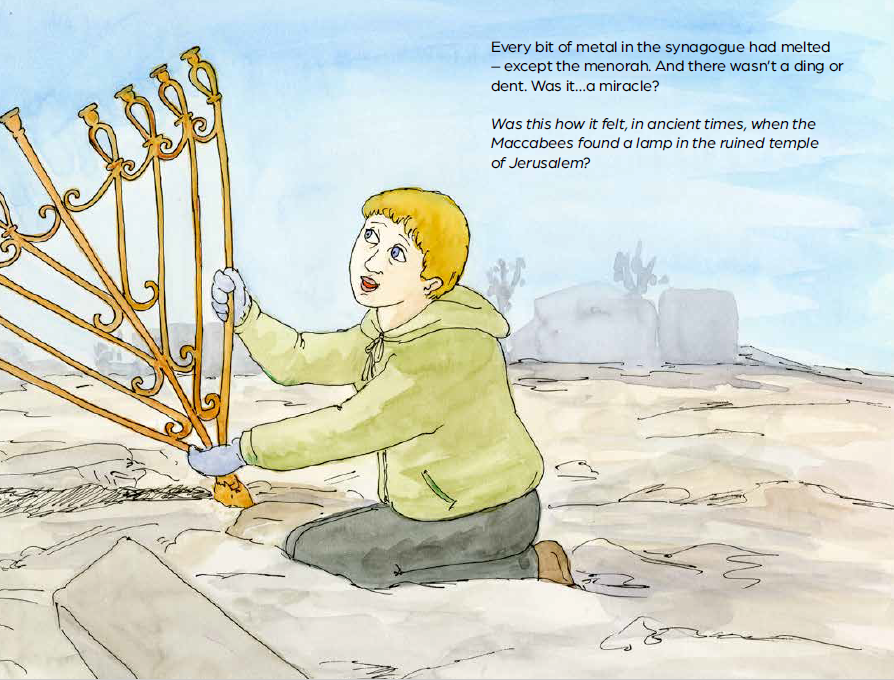
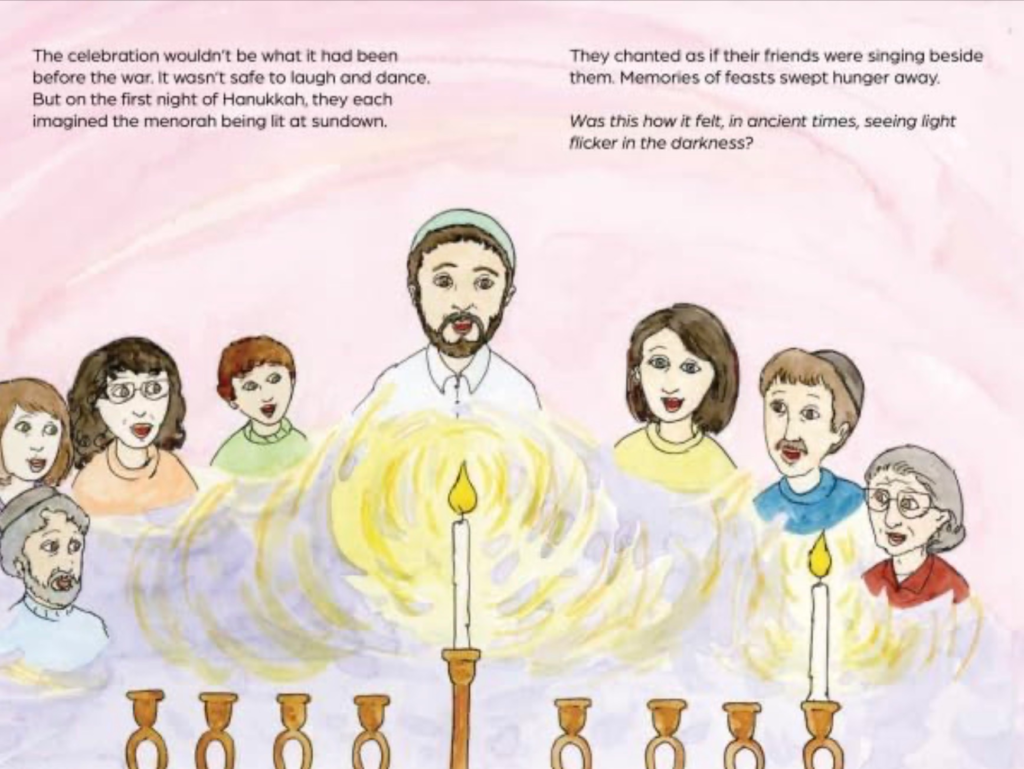
Illustrations by Marissa Moss from The Miracle Menorah of Mariupol.
Q. Usually, you relate a simple straightforward story. Until now, the only exception was Martin & Anne, which we discussed in depth in your earlier interview in January. It had two separate biographies interwoven. This time, you wove together the Hanukah story and the war in Ukraine. What inspired weaving together the two narratives?
A. In the Jewish tradition we are asked to tell stories as if they are happening to us now, to feel what our ancestors were feeling even as old stories add fresh feelings from new circumstances. From the moment I learned about this menorah discovered in ravaged Mariupol I flashed to how it must have felt when the menorah was found in the First Temple that the Maccabees had reclaimed. It would not leave my mind or my heart of the faith it must have taken long ago to light candles when war is raging, when it did not even seem as if there would be enough purified oil to last until more arrived, of how much courage it took to light candles now, more recently, in Mariupol, in the midst of a war against those who were similarly trying to extinguish the identity of a people, to blot out hope and joy.
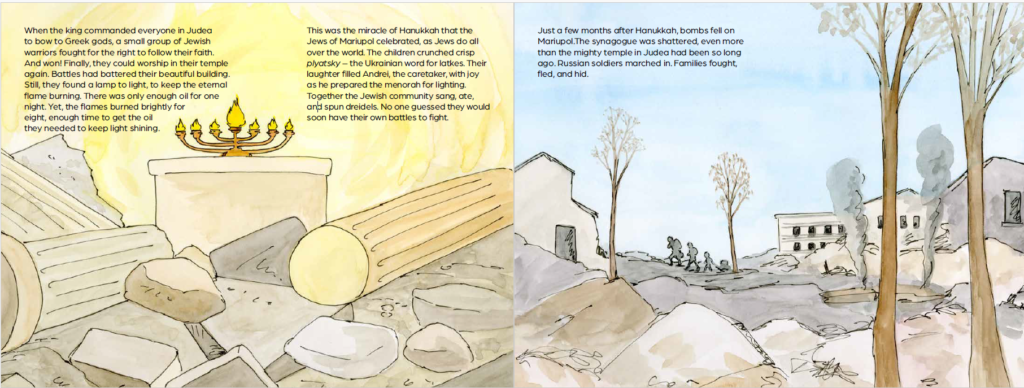
– Illustration by Merissa Moss from Miracle Menorah of Mariupol..
Q. I found it interesting that you talk directly to the reader, inviting them to put themselves in the place of the people in Mariupol. Why did you do that?
A. I did that in the opening of Dear Mr. Dickens to invite young readers into a story that challenged them to think about what decision they might make if they saw injustice but were at risk if they pointed that out as Eliza Davis was. This was a more extensive back and forth because I believe what makes this story vital is seeing the parallels between ancient times and ours. Hanukkah celebrations usually revolve around fun – and that is important! But I feel that kids benefit from knowing that Hanukkah is also a story about bringing light into the world, as you do by lighting candles, even when the world seems dark.
Throughout history, Jewish people have lit candles and held Seders and honored traditions when forbidden to do so by the societies in which they lived. They took these risks because they knew that carrying on traditions solders precious links that connect us from our past to our present and, ultimately, our future. These traditions have value in and of themselves, but they also make a statement that we have a right and duty to be who we are, to live what we believe, to pass hopes and dreams to the next generation.
Q. Tell us about your historical research process.
A. The research process varies depending on the story. Because there hadn’t been much written about William Hoy, I navigated mountains of newspaper articles as well as consulting experts like my friend Steve Sandy, who was a friend of the Hoy family, and Eric Nadel, a Major League Baseball Hall of Fame Announcer who had written books about baseball and knew all about Hoy.
Because the story of the menorah being discovered and lit was a recent event, I needed to consult with someone who was part of the story. I am grateful for the encouragement and help I received from Rabbi Mendel Cohen, the rabbi of the synagogue whom the caretaker, Andrey, consulted. I also talked with Dovid Margolin who wrote the original newspaper stories about the event. I am also very grateful to Ukrainian photographer Alise Rostovtseva for providing her photographs of the menorah, especially as it had been lit in happier days. She helped illustrator Marissa Moss and me to see and feel the wonder of the moment that inspired this story. I am thankful and proud that Rabbi Cohen shared his wisdom in the back matter and on the back cover of the book.
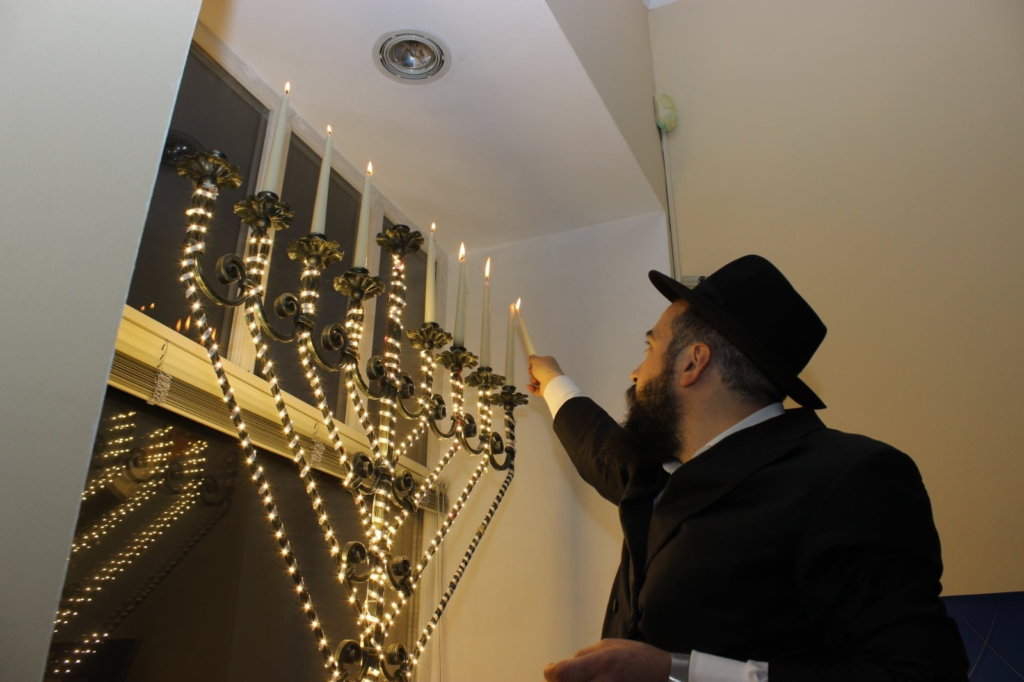
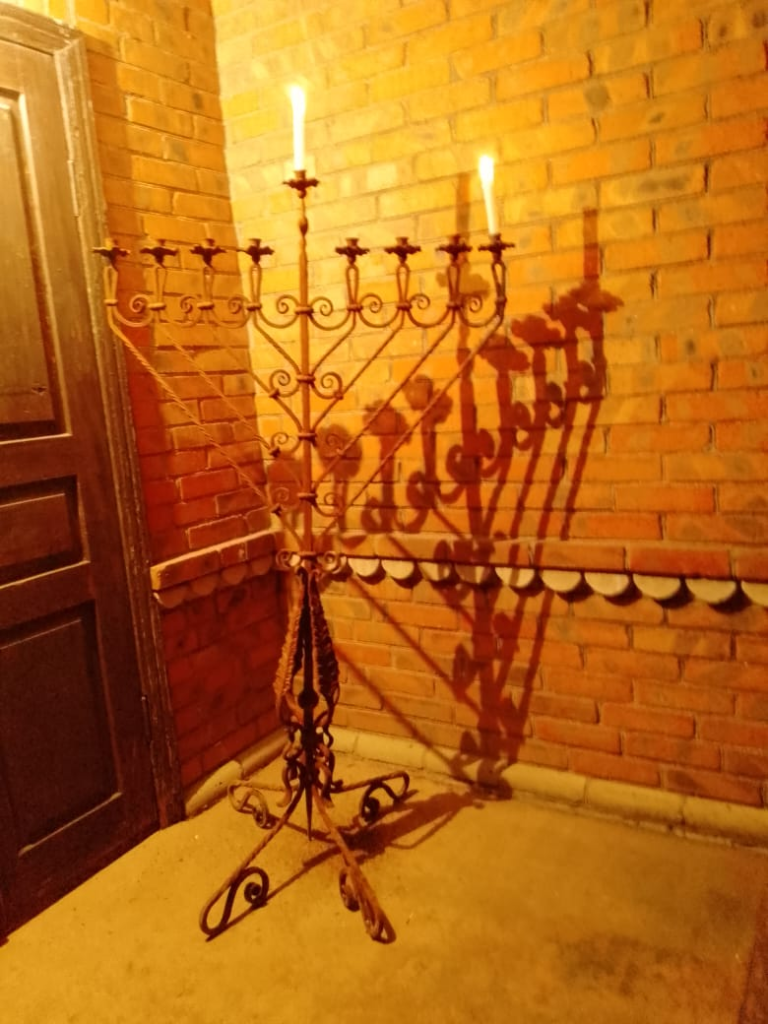
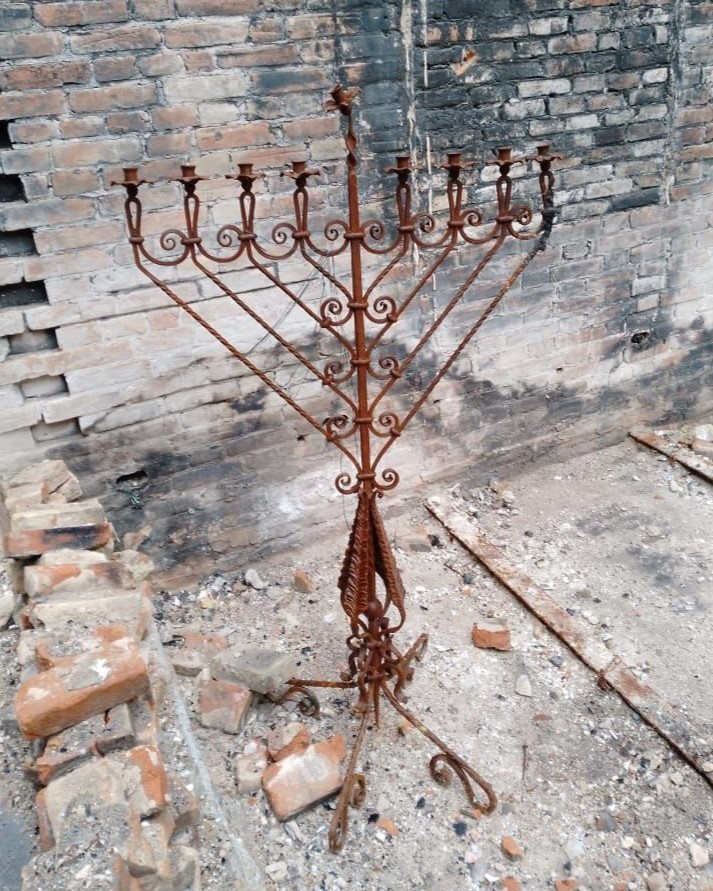
Photographs courtesy of Alise Rostovtseva
Q. Every one of your books has resources for parents and teachers. How did you end up arranging for teacher’s guides and children’s activities?
A. My mother was a teacher, and I would never put a book out into the world without a teacher guide! Some of my editors and publishers have provided teacher guides, including Marissa Moss who is the publisher, editor, and illustrator of The Miracle Menorah of Mariupol. When my publishers don’t provide teacher guides, I commission them from educators. I have turned to a variety of wonderful providers including Marcie Colleen, Stephanie Fitzpatrick of Book Links LLC, and Sandy Karas, who made her activities free to download on Teachers Pay Teachers.
Q. For a little bit of whimsy, I know that you were a theater critic and love musicals. When asked in one interview to pick a song that represented your book, Rainbow Allies, you chose “Love thy Neighbor” from Prom. In another interview, you mentioned that the kids learned to care about their neighbors from their parents, and you referenced “You Have to be Carefully Taught” from Rodger and Hammerstein’s South Pacific. Is there a song that you feel represents The Miracle Menorah of Mariupol?
A. Great question! If we are sticking with musical theater, I have to go with “Miracle of Miracles,” a favorite from Fiddler on the Roof that references multiple miracles, noting that the greatest miracle is love.Another song outside the musical theater world that captures the feeling is “Not by Might, Not by Power” by the wonderful Debbie Friedman.
Q. You have several books scheduled for release. Please tell my readers about your books in the works.
A. I have five books coming out in 2027. I can hardly believe it! We Thank Our Trees, a Tu B’Shevat Story, illustrated by Bindy James, is a picture book about the diversity of our trees, the gifts they give us, and how we can thank them. It’s coming out January 5 from Kar-Ben.
Snail’s Perfect Passover, illustrated by Alianna Rozentzveig, is my first fiction picture book. This joyful journey shares the story of a Snail whose perfect Passover plans for his friends are ruined – or are they? — when his friends bring an unexpected guest. It’s coming February 2 from Kalaniot Books.
A Horse and Her Girl, the Story of Black Beauty and Anna Sewell, illustrated by Brie Schmida, is a picture book about Anna Sewell, the first person to write a story from a horse’s point of view, told from Anna’s horse’s point of view! It will be released in April 2027 from Albert Whitman.
1000 Red Stitches, Robert Yano and the WWII 442nd Regiment, illustrated by Kathryn Otoshi, is a picture book about Robert Yano who was interned in a camp for Japanese Americans during WWII and volunteered and fought for his country in the 442nd Regiment, wearing a traditional Japanese senninbari sash of 1000 red stitches that honored his heritage under his uniform. It will launch in May 2027 from Creston Books.
Diana with an ‘ee’, co-authored with Diana Serna Aguilera, illustrated by Sergio D. Robleto, is a picture book about the walkout Diana and her friends organized as teens as they demanded equal rights for Chicano students in their school in Crystal City, Texas in 1969. It will be published in English and Spanish on every spread in Fall 2027 by Lil’ Libros.
Thank you, Julie, for the opportunity to share my journey in this wonderful interview!
The Miracle Menorah of Mariupol
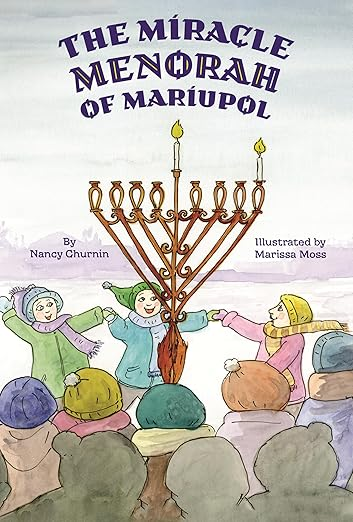
The Miracle Menorah of Mariupol
by Nancy Churnin
Illustration by Marissa Moss
Publisher by: Creston Books on September 1, 2026
32 pages
Picture Book Biography

Hanukkah is a holiday known for the miracle of the oil, of light lasting longer than was thought possible. This is the story of a modern-day Hanukkah miracle, a menorah bringing light when it’s needed most.
When the synagogue of Mariupol was bombed by Russia in 2022, everyone thought the large menorah that was the center of the Jewish community’s Hanukkah celebration was destroyed. But in a modern-day Hanukkah miracle, the menorah was found, just in time to bring its light to the Jews of Mariupol, now refugees scattered all over the world. The candles were lit by a Ukrainian helper and drove away the darkness, uniting everyone in the warm glow of hope.
Storybook Lady
Review
The Miracle Menorah of Mariupol
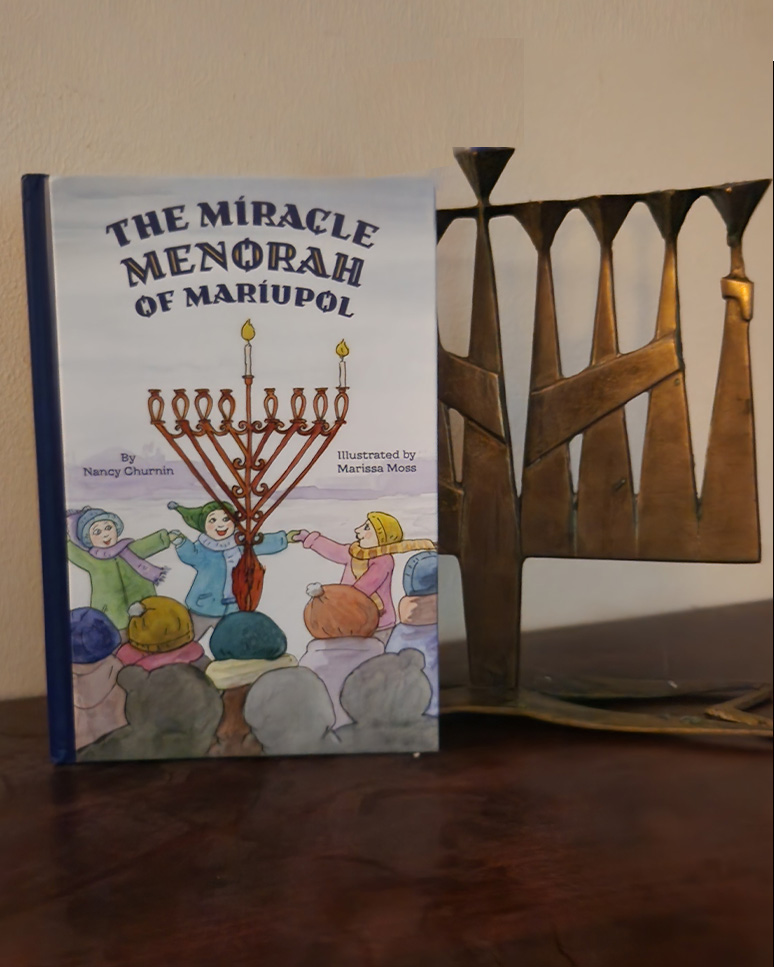
Nancy Churnin has used a true story to explain the current war in Ukraine in a manner that youngsters can relate to. She intersperses the story of Hanukkah and current events, comparing the two, to teach children about both the ancient history of holiday and the recent history in Europe.
She begins the story at Hanukkah, with everyone surrounding the giant menorah outside the temple. Here she explains the history of Hanukkah, the Maccabees and the miracle of the oil. But then she writes about the Russian’s bombing Ukraine and how the temples were destroyed. Some people fled, others went into hiding. Miraculously, although all other metal had melted, the giant menorah was discovered intact among all the rubble. The knowledge that the menorah had survived and was being lit during the holiday, brought light and hope to the community far and wide. Even those across the world, who would not be there to see it lit, would be able to imagine it and take hope. The author compares the Maccabees to the Ukrainian people. She highlight the fact that both times, a menorah survived a destroyed temple. Throughout the book, the author directly speaks to the reader asking them questions, inviting discussion between the children and adults who may be sharing the book. Although this is a picture book, the text is written at a level for school age children. This book can be read to preschoolers or read by older children. Although on the surface this story is about a menorah, It is not a holiday book. It can be read by children of any faith at anytime of the year. The true miracle of Mariupol is their sense of community and the light that hope provides.
Learn More about Nancy Churnin
Find out more about Nancy and her books at nancychurnin.com
You can learn about all her books and download teacher guides and activities for each one.
Follow Julie Ditton, Storybook Lady on Social media:
Want to read more of my reviews?
I have several dedicated shelves on Goodreads. Read all my reviews of books by Nancy Churnin and other children’s biographies. Check out my reviews of many other Jewish Children’s books on my Goodreads Bubbe’s Bookshelf. For a wider selection of books for kids, you will find them all on my Children’s Books shelf.
Want to read my reviews for books in other genres? I’ve got you covered. There are over two thousand reviews on my profile. Just check out Julie Ditton on Goodreads.