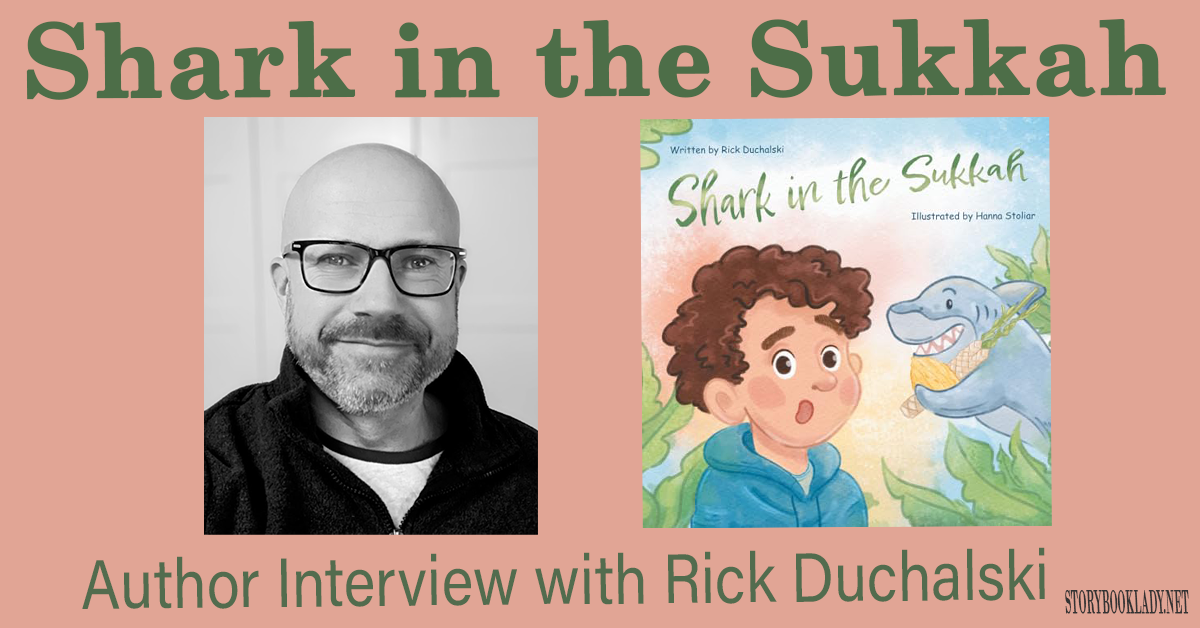
Rick Duchalski Jaws about Shark in the Sukkah and Mad Dreidel
Rich Duchalski, founder of Mad Dreidel Press has just released his third book, Shark in the Sukkah. The publisher uses the taglaine, “Not Your Boubby’s Picture Books.” But this Bubbe loves them! Rick has graciously answered a few of my questions about this new venture and heis most recent book.
About Rick Duchalski
About Rick Duchalski

Rick Duchalski writes funny Jewish picture books, teaches Hebrew school, and runs Mad Dreidel Press. His work celebrates Jewish joy, mischievous children, and the firm conviction that no holiday is completely safe from chaos.
Interview with Rick Duchalski
Julie: Your newest book Shark in Sukkah is only the third book in your new independent publishing company, Mad Dreidel Press. You have a long career in technical writing and education. Why did you start writing Jewish picture books?
Rick: I’ve been one of the resident storytellers at Solel Congregation, our little Reform shul here in Mississauga, for more than a decade, and so all of my stories came from ones I wrote for the bet sefer kids there. When I started out reading from the picture books we had in the shul, I noticed something interesting: when it comes to books that come from authors like Robert Munsch, or Dr. Seuss, or Mo Willems, etc., kids not only love them; they ask for them again and again (looking at you, Pigeon driving the bus…).
But for the Jewish picture books we had on hand, that wasn’t happening. Kids were listening, but they weren’t rolling on the floor laughing, or clamoring for me to tell them again and again. With all due respect to the Jewish bookshelf, many of the things we offer little kids in picture book form lead with lessons and instruction – they’re too didactic to be fun (although there are obvious exceptions—Baxter, The Pig Who Wanted to Be Kosher is one of my favorites). So I thought, why can’t we have clearly Jewish books for kids that are just silly first (and maybe have a lesson baked in somewhere).
If you think about it, we already do this for adults in our community: we have very Jewish movies like Fiddler on the Roof, which has weight and is a cultural touchstone. But we also have Mel Brooks movies, which are clearly very Jewish, but are really just there to make you laugh. In a sense, what I’m trying to do is give our kids the Mel Brooks version of picture books.
The other thing is that representation matters, and Jewish kids deserve to see themselves in more than just holiday procedural stories or ones that are basically object lessons. Fun, silly, exciting adventures that happen to be Jewish. Our kids deserve more of those. We’re actually pretty good at those at the middle-grade level, but there is still a lot of lag in the picture book genre.
Julie: You decided to form your own publishing company. Tell me about Mad Dreidel Press.
Rick:After years of shopping my manuscripts to agents and publishers (both Jewish and non), I suspected something was going on: I knew these stories were wacky and strange, and it seemed as though people didn’t know what to do with them (even PJ Library turned them down!). My hunch is that they’re just not traditional enough for a decision-maker to look at them and say, ah, I know exactly how to market this.
And yet, over the years, there has never been a single moment when I doubted the viability of these books – I knew they would land if I could get them into people’s hands. So, I decided to do it myself.
It’s true that there are just three books out now, but I’ve got 10 more manuscripts in the pipeline, and I’m on the verge of signing my first outside author, which I’m incredibly excited about. I don’t want to say too much yet, but what we have in the works with his story, and the illustrator we have lined up, will plant a giant rainbow flag right in the middle of the bookshelf to make sure we’re representing even more families in the community. And it’s HILARIOUS.
That said, publishing in general is hard, margins are thin, and the biggest bottleneck we’re facing is funding. If I can solve that part, we’ll be off to the races.
Julie: I love Shark in the Sukkah. What inspired this story?
Rick: About eight years ago, I jotted down an idea called That Doesn’t Go in a Sukkah, Max! But the story was going to veer into territory I was trying to avoid: a kid doesn’t understand the holiday, tries to figure it out using childlike innocence, an all-knowing adult corrects them, and that’s it. But that’s boring.
So I asked: what’s the strangest thing that could be in a sukkah? The idea of a shark made me laugh so hard I had to build a story around it. And that all comes back to the very simple formula I always start with: What is going to make them laugh? If I don’t have that, I don’t write it.
Julie: It is such a silly idea. But although the story takes place during sukkot that is really just the framework for the setting. It isn’t about Sukkot and doesn’t even take place in the sukkah. In fact we barely even see the shark. Everyone is so upset about the shark, that they keep trying to figure out what to do. How did the silly phrase about a sukkah become a story about communication?
Rick: I spoke earlier about representation, and I’m particularly interested in representation that places Jewish life as a setting, rather than the subject. We already have lots of books about what the holidays are, what people do, the values they try to instill, etc. So ‘what Sukkot is’ was never the focus. Once that picture of Jewish life was set, though, what I really wanted to do was center a universal experience for kids (Jewish and non-Jewish): the fact that adults don’t listen to them.
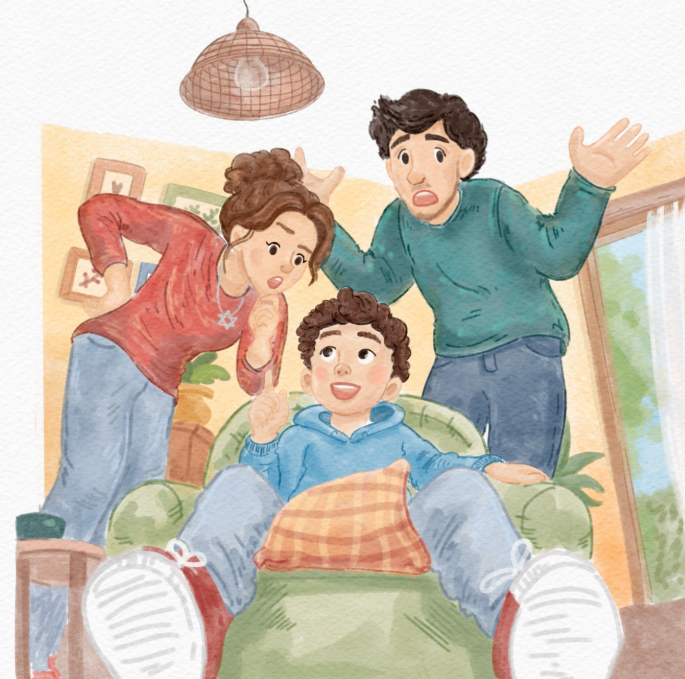
“—the neighbours?! Great idea!” they exclaimed.
It looks like the central problem of the story is that there is a shark in the sukkah, but the real problem is that no one listens to the kid, who actually has a very clear idea about a solution. And this brings us to the other element that I try to keep central in all my stories: the kid must be the hero. They need to navigate the adventure, stand up against the odds, and come out the other side as the hero. That’s one of the key things that will keep kids coming back for more.
Julie: Other than a good belly laugh, what do you hope that kids take away from your story?
Rick: Here’s my biggest hope, and it goes beyond what’s in the story. Living in Mississauga, there aren’t a lot of Jews here. Interestingly though, I’ve had the opportunity to tell these stories in public schools to literally hundreds of non-Jewish kids, and they think they’re hilarious. And here’s what I realized is happening (and can happen):
Most schools have a Jewish heritage month (May), and if they do anything at all, they will basically pull some standard curriculum out and maybe a book or two about a holiday. But the practical effect of that is that the non-Jewish students are effectively looking across the table at the material and their Jewish friends as subjects of study – that their Jewish-ness is something to be taken down off the shelf, studied, and put back. With my stories, though, I realized that non-Jewish students were laughing alongside their Jewish friends – laughing together at the same adventure. In a way, this is a callback to the Mel Brooks comparison. Loads of non-Jews love those movies; they may not get every joke, but they know it’s funny, and we can laugh together.
And in this sense, the students are now sitting on the same side of the table, together as co-conspirators in the chaos. I’m also developing lesson plans for teachers that allow them to pull out specifically Jewish topics as well as more universal ones, so this distinctly Jewish book becomes source material for greater learning.
Julie: Speaking of communication, in traditional publishing the author and the illustrator work independently. Sometimes the author may have a few art notes with ideas that they want to make sure are included. But your website talks about author, – illustrator collaboration. Tell me about working with Hanna Sotliar.
Rick: The great thing about Hanna is that she’s a genius. Interestingly though, I’ve never actually met her in person! She’s Ukrainian, but currently living in Georgia, and we do all our work virtually. So let me first give you a sense of what I give her to work with.
I’m finicky about story structure, including the visual structure. I’ve written a novel and screenplays, and my picture books follow a three-act arc. As I write, I storyboard the pages so a turn can deliver a reveal at just the right moment. Hanna gets detailed, page-by-page notes. Then I need her to get weird with them—because I can’t draw to save my life.
When I first approached Hanna, I did give her all of those notes and storyboards, but then I needed her to unlock her creativity – and not just give me what she thinks I wanted. With artists, they often have an ocean of creativity in their brains, but they shrink it down to a river or a stream for the client. I didn’t want that. I wanted her to do things with the illustrations that I couldn’t possibly think of, precisely because I’m not a visual artist.
So I told her that I wanted her to surprise not just me, but herself. Take it to a place that is unexpected. And sometimes it’s big things, sometimes little subtleties. In Don’t Unbraid the Challah!, we both knew we wanted to set it in Poland, but she was able to add touches that I could never think of, right down to the books on the bookshelf in the Bubby’s dining room. And this is what I mean by author-illustrator collaboration: I want my artists to take off the reins, start running, and see where it takes them. And if we have to modify the text because of what is happening on the page visually, let’s talk it out. It’s a visual medium, after all.
Julie: Your story has one funny bit mentioning that some very curious ducks who join the crowd of townsfolk in the kitchen. It is one funny paragraph. But those ducks keep showing up in the illustrations, doing the funniest things. It is almost a subplot within the story. Tell me about that.
Rick: My wife is a learning disabilities and literacy expert, so we often have conversations about developmental milestones, accessibility, literacy readiness, etc. In the case of Shark, the ducks are there to give pre-readers and early readers a way of engaging with the book beyond just passive listening. Now we’re engaging with this cool thing called a ‘book’. And they learn that it’s a source of boundless adventure even if they aren’t old enough to read the words yet. There’s a great example of this with the mice at the bottom of the pages in Phoebe Gilman’s Something From Nothing. It’s also the reason Where’s Waldo books were so popular.
Now, when a little kid sees the book on the shelf (or any book like it), it’s not just a flat thing with words; it’s what made that really fun time they had with Mom the other night when they were trying to find all the sneaky things the ducks were doing. Budding communicators just learning to engage with books. That’s magic.
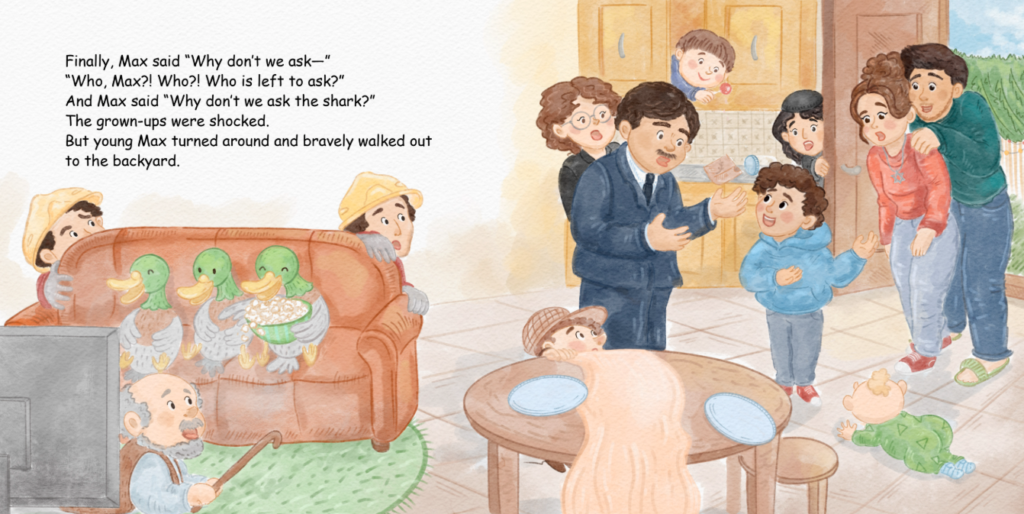
– kids can find the ducks doing silly stuff throughout the story.
Julie:What can we expect next? Do you have any more books coming out soon?
Rick: As I mentioned, I’ve got a whole backlog of manuscripts, ready to roll, and new authors are approaching me all the time. If all goes well, we’ll be able to roll out my new author’s book in the new year, but the big constraint is financial (getting Mad Dreidel Press off the ground was purely self-funded). But as the saying goes: Es iz gringer oyftsuheybn a shiker fun der erd eyder a gesheft (It’s easier to get a drunkard off the ground than a business).
About The Book
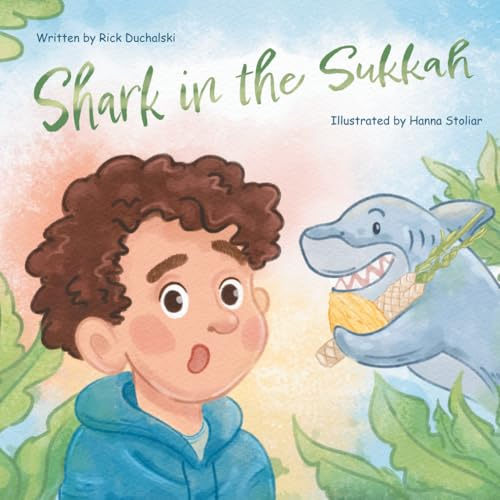 Shark in the Sukkah
by Rick Duchalski
Illustrator: Hanna Stoliar
Published by Mad Dreidel Press on June 8, 2026
Pages: 32
Genres: Juvenile Fiction / Holidays & Celebrations / Jewish, Juvenile Fiction / Humorous Stories, Juvenile Fiction / Religious / Jewish
Add to Goodreads
On the second morning of Sukkot, Max discovers something unexpected in his family's sukkah: a shark.
At first, nobody believes him. But when his parents investigate for themselves, they come running back into the house screaming. Before long, the neighbours are involved. Then the neighbours' neighbours. Soon the entire town is trying to solve the problem, including the rabbi, the mayor, the fire department, a local fisherman, and even a few very curious ducks.
Everyone has an opinion. Everyone has a plan. Unfortunately, nobody seems to know what to do next.
Set during a springtime Sukkot celebration in Argentina, Shark in the Sukkah is a humorous picture book about community, curiosity, and the importance of asking the right questions. As the adults become increasingly worried, young Max discovers the value of yishuv ha-da'at-clear-headed thinking in the face of confusion, excitement, and uncertainty.
Filled with laugh-out-loud moments, memorable characters, and delightfully escalating chaos, this story introduces young readers to Sukkot through a fresh and imaginative adventure. While rooted in Jewish life and tradition, the story's themes of problem-solving, empathy, and critical thinking will resonate with readers of all backgrounds.
Featuring a unique South American setting, Shark in the Sukkah also offers readers a glimpse of a springtime Sukkot celebration that may look different from those experienced in North America. Through humour and absurdity, the story highlights the diversity of Jewish communities around the world while reminding readers that sometimes the simplest solution is the one nobody has considered.
Perfect for children ages 4-8, family read-alouds, classrooms, libraries, holiday programming, and anyone who enjoys funny picture books with heart.

Storybook Lady
Review
Silly Sukkah Story
Rick Duchalski has created another silly story to make Jewish kids laugh. How would you react if you found a shark in the sukkah? The story isn’t really about Sukkot. You won’t learn about the holiday. But readers will have a good laugh. Everyone is wondering what to do, who might have a good idea? It makes fun of the adults, who keep jumping to conclusions. Kids might even realize before the end that Max is the one who knows what question to really ask. I love Duchalski’s silly sense of humor. But artist Hanna Stoliar gets in the act too. The pictureswith the parents building a donut tower and the illustration of the shark relaxing in the sukkah wirth a glass of oj is just silly. But the artist also slips in some sly wit too that grandparents or great grandparents might notice. The shark reminded me of “Charlie the Tuna” and the fisherman looked a little like the one who is on the box of a certain frozen fish brand. This Sukkot book has something for everyone from baby to bubbe.
Learn More about Mad Dreidel Press
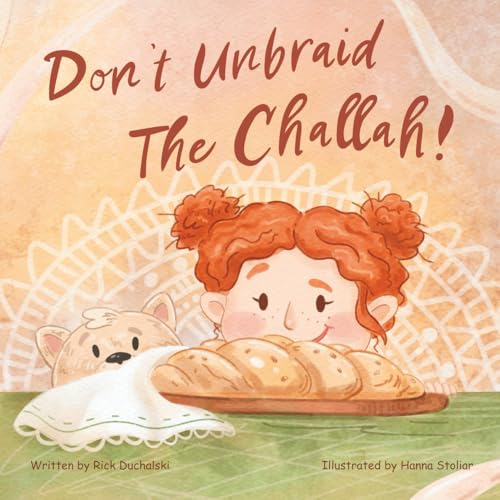
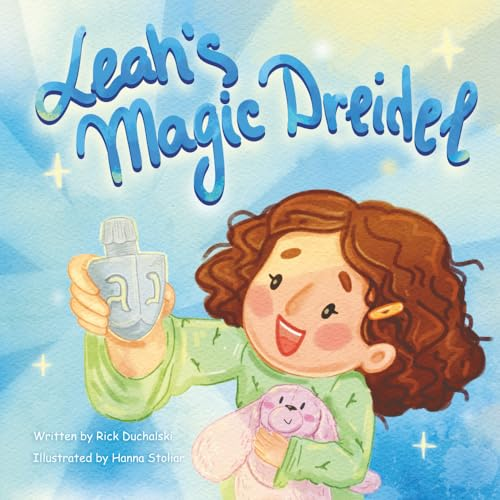
Find out more about Rick Duchalski and his books at maddreidelpress.com
-You can learn about his books and buy them at major retail cites through the links on his book page.
Want more Sukkot Reviews
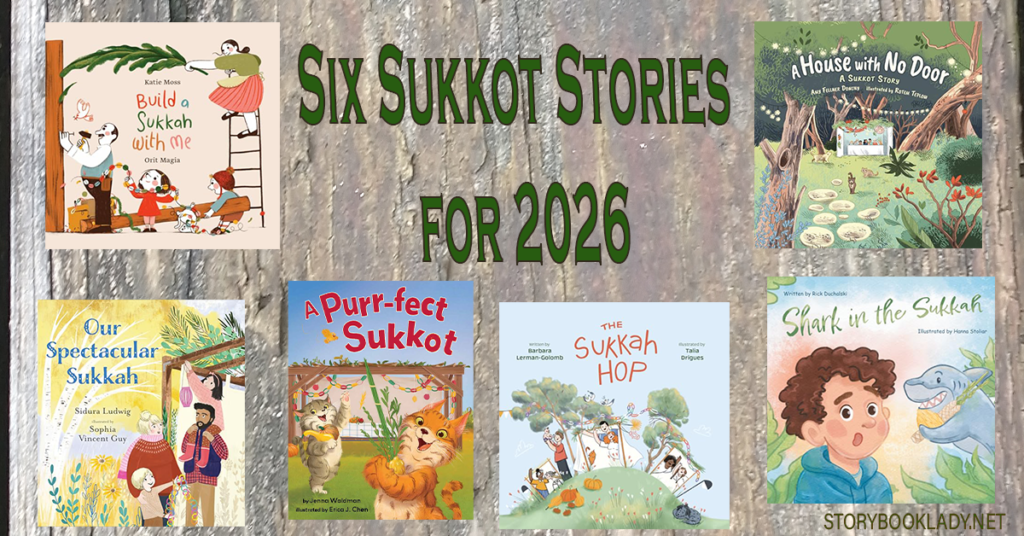
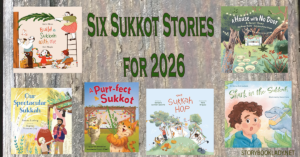
SIX SUKKOT STORIES for 2026
This year brings a bumper crop of new Sukkot picture books to share. Read about the harvest of this year’s Sukkot stories and follow the links to the author interviews and guest post that follows.
SUKKOT ARCHIVE
Read about this year’s crop and Sukkot picture book favorites from recent years. Find all the Sukkot Reviews and Interviews on Storybooklady.net